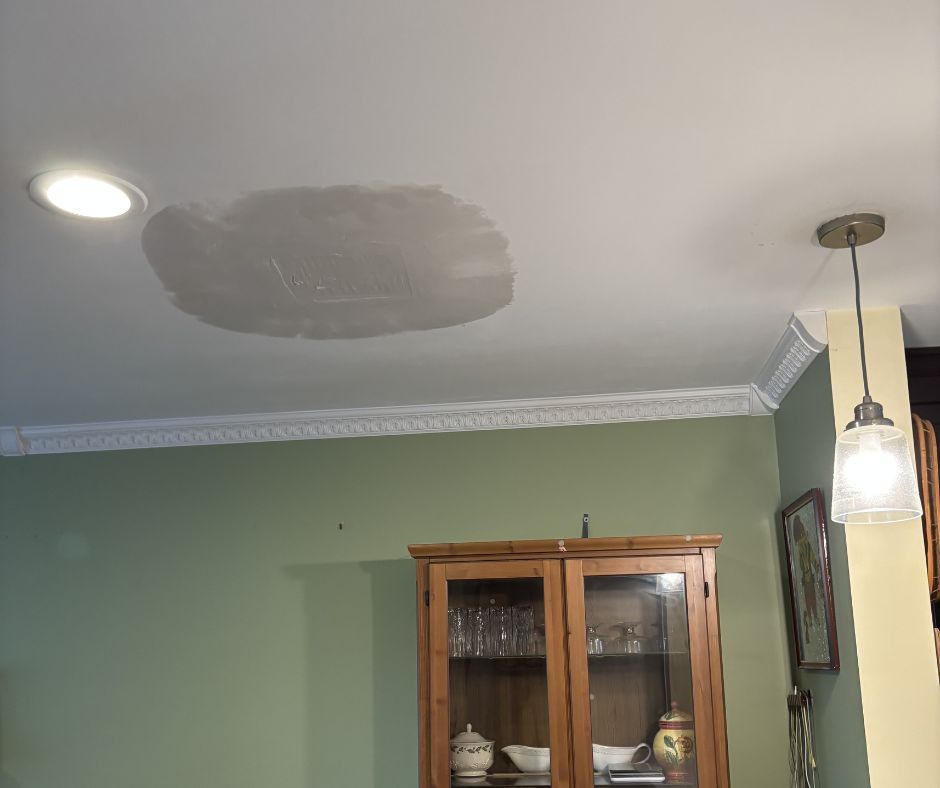
It can seem odd to hire someone to fix a hole in your wall and then watch the opening get bigger.
You might reasonably ask, “Why can’t you just patch what is already there?”
That is a fair question. Before starting, I want to explain what I plan to remove and why.
I’m Chris, the owner of Fast Patch Drywall Repair. I help Bergen County homeowners with drywall, plaster, and ceiling repairs. My goal is to keep the work as limited as practical while giving the finished repair a sound starting point.
The Visible Hole Does Not Always Show All the Damage
I check the surrounding edges, not just the opening. Crumbling material, distorted board, or damage extending behind the surface can mean the repair needs to reach farther out. Sometimes the front looks acceptable while the back has broken away, leaving less sound material than it appears. Fast Patch Drywall
That is why I do not decide the final patch size from a close-up photo alone.
Surface Damage and a Broken Board Are Different Problems
Not every blemish calls for cutting out drywall.
Small dents and limited damage to the face paper can often be repaired by removing loose material and preparing and refinishing the surface. That is different from replacing a section of damaged board. USG
I want to make that distinction before turning a surface repair into an unnecessary opening.
Sometimes the Surrounding Drywall Can Be Secured
Where the existing board is still sound, I may add screws into the framing around the opening to stabilize it. I also sometimes compare the sound of a questionable area with a nearby sound section by gently tapping. That is one clue—not a stand-alone test or proof that the material should stay. Fast Patch Drywall
Proper fastening matters: screws must engage the intended support, and their heads should sit correctly without tearing through the face paper. Driving a screw deeper is not a substitute for a secure attachment. USG
These are checks I make as part of assessing the repair. Please do not push on or disturb a wet, bulging, or sagging ceiling to test it yourself.
The New Patch Needs Support, Too
A replacement piece needs more than a snug fit in the opening. It needs an appropriate attachment method, followed by properly taped and finished joints. Depending on the repair, framing or suitable repair supports provide that attachment. The compound comes afterward to finish the surface. USG
When explaining a larger opening, I want to show you how it fits into the repair—not simply say, “That’s how I always do it.”
Drying Out Does Not Automatically Make Damaged Drywall Usable
For water-exposed drywall, the decision involves more than whether it feels dry today. The source and duration of the water exposure matter, along with drying conditions and whether the board remains physically sound. Separating paper and other damage that weakens the board are reasons replacement may be necessary. American Gypsum
Sewage or floodwater exposure is a different situation again: affected drywall needs replacing, and contamination must be addressed before ordinary reconstruction. A firmness check or a few additional screws cannot resolve that concern. Gypsum Association
Let me know what caused the damage and what cleanup or drying has already been completed.
The Goal Is the Right-Sized Repair
I do not want you paying to replace good material unnecessarily. I also do not want to leave questionable material simply to make the opening look smaller.
Before the finishing starts, I want us to have a clear understanding of what can stay, what needs replacing, and what the completed work will include.
The aim is not the smallest possible patch. It is the smallest repair that properly addresses the problem.
Not Sure How Much of Your Wall or Ceiling Needs Replacing?
Call or text Chris at 201-822-5593.
Send a close-up of the damage, a wider photo showing its location, your town, and a brief description of what happened. Mention any previous repairs or water damage.
You do not need to enlarge the opening before contacting me. Start with photos of the area as it is, and we can discuss the next step.