
When people think about drywall repair mistakes, they usually think about things like bad taping, too much joint compound, poorly set screws, or a patch that does not blend properly.
Those mistakes matter, but in my opinion they are not the worst thing that can happen.
The biggest mistake you can make during a drywall repair is cutting into something hidden behind the wall or ceiling.
That can turn a small repair into a much bigger problem very quickly.
What Can Be Hidden Behind Drywall?
When drywall is installed, plumbing pipes, electrical wires, low-voltage wires, ductwork, and other mechanical systems may be very close behind the surface.
In some cases, there is very little space between the back of the drywall and what is behind it.
I have opened ceilings where plumbing pipes or electrical wires were literally lying right against the back of the drywall.
That means an aggressive cut can do a lot of damage before you even realize what happened.
Why the First Cut Matters
The first step in many drywall repairs is removing the damaged section and cleaning up the opening so a new piece can be installed.
This is where people can get into trouble.
A reciprocating saw, drywall saw, or other aggressive cutting tool can easily go deeper than expected.
If there is a pipe or wire directly behind the surface, it may only take one bad cut to create a leak, electrical problem, or expensive repair.
Why I Prefer an Oscillating Tool
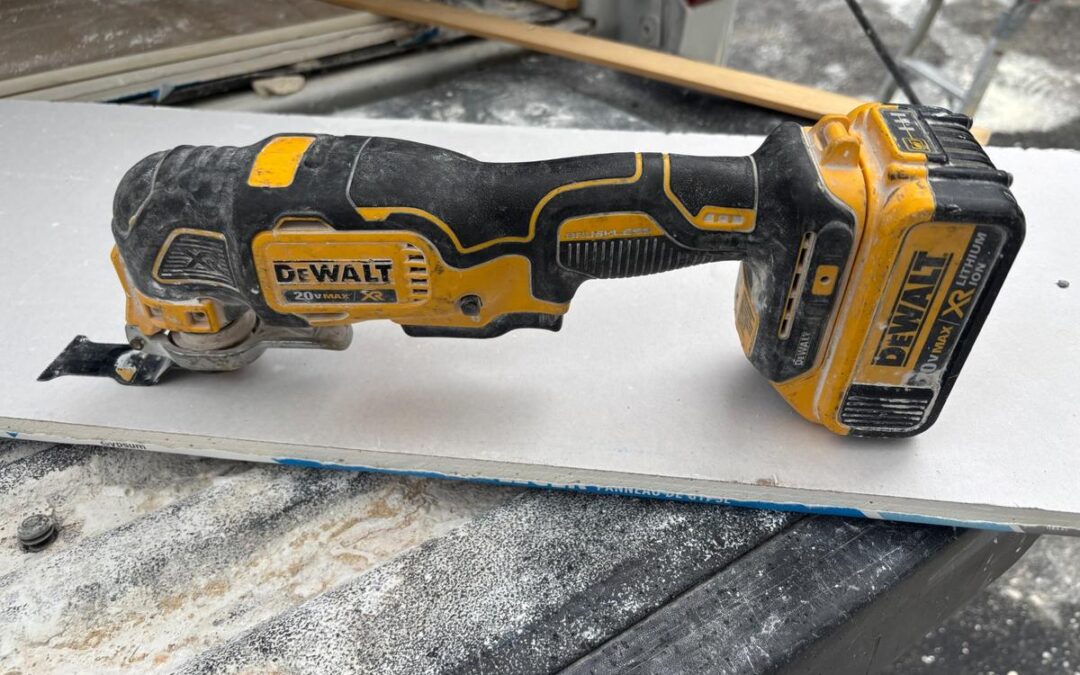
For many drywall repairs, I prefer an oscillating multi-tool with a straight blade.
It gives you more control over the depth of cut and lets you work slowly around the opening.
If you are unsure about cutting depth, one simple trick is to put a piece of painter’s tape on the blade at approximately the thickness of the drywall.
Most standard drywall is 1/2 inch thick.
The tape gives you a visual reference so you are less likely to plunge the blade too deep.
It is still important to work carefully and remember that drywall thickness can vary, especially in older homes or where multiple layers are present.
Slow Down Around Suspicious Areas
Be especially careful near plumbing fixtures, kitchens and bathrooms, electrical outlets and switches, ceiling lights, heating and cooling equipment, and areas that were previously remodeled.
If something does not look right, stop and investigate before continuing.
Taking an extra few minutes is much better than cutting through a water line or electrical cable.
The Patch Starts Before the Spackle
A good drywall repair is not just about how smooth the joint compound looks when you are finished.
The repair starts with safe, careful preparation.
Knowing how much material to remove, what may be behind the surface, and how to prepare the opening properly is just as important as taping and finishing.
Many drywall mistakes can be repaired.
A damaged pipe or electrical wire is one mistake you are much better off avoiding in the first place.