
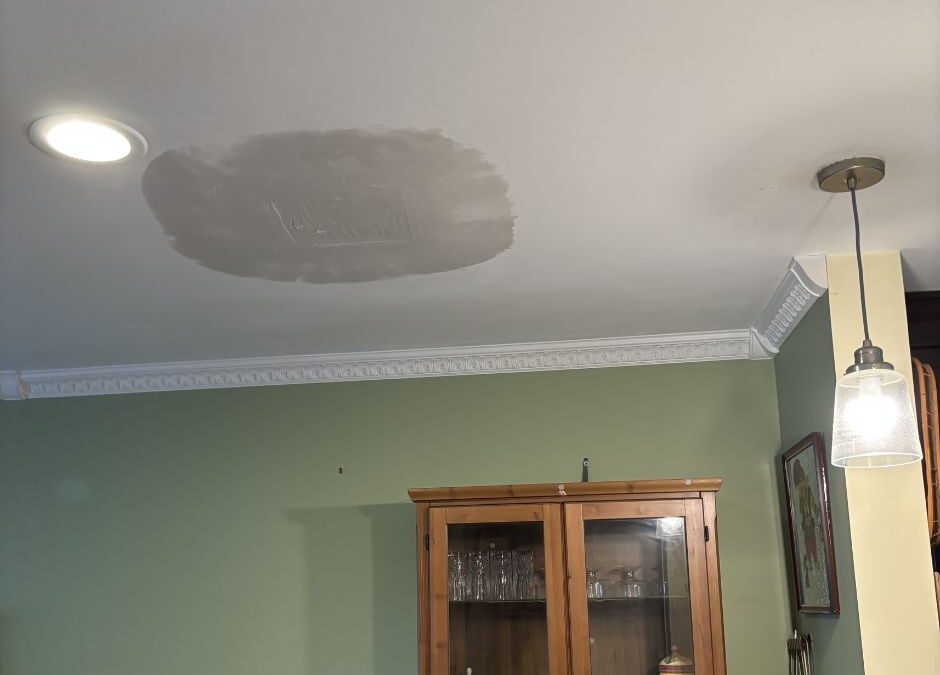
One of the most important decisions in a drywall repair happens before any new drywall or joint compound is installed.
How much of the damaged material should be removed?
It can be tempting to leave as much of the existing drywall as possible, especially if only one area looks bad.
But a repair is only as strong as the material surrounding it.
If you try to attach a patch to drywall that is already soft, loose, bulged, or damaged, you may be building a good repair onto a bad foundation.
Do Not Stop at the Visible Damage
The visible hole is not always the full extent of the problem.
Water damage, impact damage, and previous repairs can weaken drywall beyond the area that looks obviously damaged.
Before installing a patch, the surrounding material should be checked carefully.
Is the Drywall Still Solid?
Good drywall should feel firm and should hold screws properly.
Some warning signs include:
- soft or crumbly drywall
- swollen or bulged areas
- damaged face paper
- loose backing
- drywall that will not hold a screw
- areas that move when pushed
- sections that dried out in a distorted shape after water damage
If the surrounding material is compromised, cutting the opening slightly larger may actually make the repair easier and more reliable.
Check the Thickness
Sometimes the front surface of the drywall looks acceptable, but the back side has blown out or deteriorated.
A piece that started out as 1/2-inch drywall may no longer be structurally sound across its full thickness.
That can make fastening a new patch difficult.
You want the edges of the repair area to be solid enough to accept screws and support the new material.
Use Screws to Stabilize the Surrounding Area
Before finishing a repair, I often add screws into existing framing around the opening.
This can help stabilize loose drywall and show whether the surrounding material is still strong enough to save.
If screws pull the drywall tight and the area becomes solid again, it may be usable.
If the drywall remains soft, loose, or distorted, more material may need to be removed.
The Knock Test Can Tell You a Lot
A simple field test is to knock on the questionable area and compare the sound with a nearby section that you know is solid.
Sound drywall usually has a consistent, firm sound.
Loose or damaged material may sound hollow, dull, or different.
It is not a perfect test by itself, but when combined with visual inspection and screw testing, it can tell you a lot.
If the area still sounds wrong and adding screws does not improve it, it may be better to cut it out.
Water-Damaged Drywall Needs Extra Attention
Water damage can be deceptive.
Drywall may dry out and still be too soft to hold fasteners properly.
It can also dry with a permanent bulge or distortion that screws will not flatten.
In those cases, trying to save the damaged section can create more work and a weaker repair.
Sometimes the best repair starts by removing a little more material.
Good Repairs Need Good Material Around Them
Spackling and finishing are only part of the job.
Knowing what to remove, what to save, and how to stabilize the surrounding area matters just as much.
You do not want to install new drywall onto adjoining material that is already compromised.
A solid repair starts with a solid base.